
You may never have heard of the suboccipitals or know that you have some, but if you’ve ever had a headache, vertigo, tinnitus, jaw pain or eye strain then you will have felt their influence.
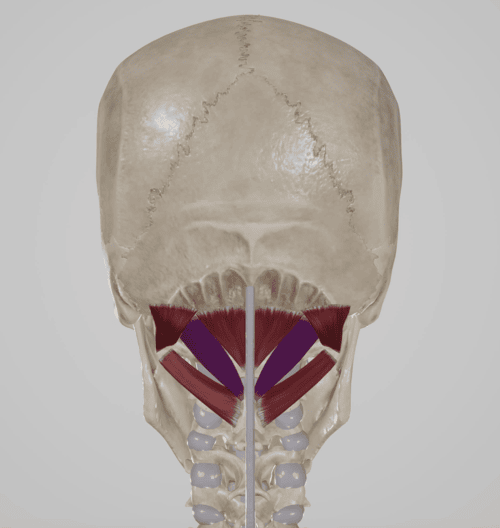
The suboccipital muscles are four pairs of small muscles located in the back of your neck in the suboccipital compartment. Their name is derived from their location – ‘sub’ meaning under and ‘occipital’ meaning the occipital bone which forms the base of your skull.
The muscle pairs are the rectus capitis posterior major, rectus capitis posterior minor, obliquus capitis superior, and obliquus capitis inferior – again these names refer to the location of the muscle pairs.
The suboccipitals are small but significant as they form a bridge between the skull and the neck. Three of the muscle pairs are directly connected to both the base of your skull and the top vertebrae in your spine, and one pair connects horizontally between the top two vertebrae in your neck. Not only do the suboccipitals have these bony connections, they also have a fascial or soft tissue connection with the layers of tissue surrounding your brain, the meninges, and the muscles of your neck, shoulders and jaw. They also form the ‘suboccipital triangle’ which is clinically significant as it contains the vertebral artery and suboccipital nerve.
The primary functions of the suboccipitals are to extend and rotate your head and in so doing they collectively act as postural support for your head and neck.
The combined position and function of the suboccipitals means they can easily become strained. This can be due to major trauma such as whiplash incidents, or due to the repetitive movement, or lack of movement, of daily life. Spending a lot of time looking at phones, tablets or screens means we natural strain our head forwards or down for prolonged periods. The suboccipitals literally have to hold on tight to enable us to also maintain head movement and rotation while doing so. This can develop into a forward head position which makes it harder work for our muscles to also allow us to look up and forwards.
Over time this creates a tightening and solidification of the fascia in the back of your neck. The fascia in your head and neck contains a lot of proprioceptors which are the nerve endings that give us our sense of where we are in space. Head and neck proprioception is important to control head position, eye movement and balance.
Typical symptoms that can result from strain and spasm in the suboccipitals can include cervicogenic headaches linked to head movement, dizziness or vertigo, tinnitus, jaw pain, jerky eye movement, and pain that can spread into your neck, shoulders and arms.
If this all sounds like bad news, there are also easy ways to help your suboccipitals to do their job more easily. To take the pressure off the back of your neck regular movement is really important – take breaks from your devices, lift your head and look around. Even small changes in what you look at – long distance versus close up – can help change muscle tension.
Doing gentle slow myofascial stretches for your neck and shoulders can help, as can using myofascial balls to release your neck. In our video we share some helpful exercises for your suboccipitals:


0 Comments