
What are trigger points?
Trigger points form in the myo-fascia of the body. Myo means muscle, and fascia is the main connective tissue in the body wrapping round and through everything else. Muscles are wrapped in several layers of fascia, from individual cells to the whole muscle.
Normally muscles work elastically to help us move and the fluidity of the fascia surrounding them allows this movement. However, sometimes small areas of muscle can be damaged. Even after the body repairs this, a tiny amount of scar tissue is left and over time this causes changes in the way the muscle and fascia around it work. This is similar to getting a snag in a jumper, where you might be able to reshape the jumper around it, but there is always a slight change to the fabric.
A snag like this in a muscle can cause the body to think there is still an injury and repeatedly try to repair damage that isn’t there. This causes more scar tissue which forms into a trigger point with associated muscle weakness, tension, stiffness and pain.
Trigger points can form in any muscle in the body and very typically an active trigger point causes referred pain and other symptoms felt elsewhere. This makes it hard sometimes to work out the root cause of chronic pain and associated symptoms.
Fortunately trigger points also have predictable pain patterns which make it easier to work out which muscle may be causing your pain.
Here are some common trigger point patterns:
Masseter
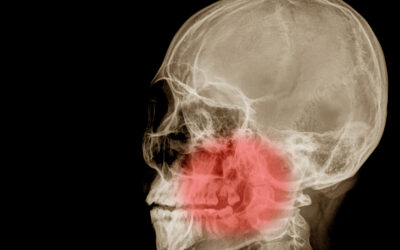
This is the main muscle of chewing and for its size is one of the strongest in the body. You have two, one on either side of your cheek.
Trigger points in the masseter are a main contributor to TMJ (temporomandibular or jaw joint) pain, pain in the teeth, face, ear and headaches as well as audio disturbances such as tinnitus.
Scalenes
These are a group of three muscles located on either side of your neck. Their main action is bending your head to the side. Their main ‘claim to fame’ is that the brachial plexus which is the main nerve bundle for the arms exits the spinal cord in the neck and passes through the scalenes.
Trigger points in the scalenes mainly cause pain lower downstream following the line of the brachial plexus. They can contribute to thoracic outlet syndrome in the chest, pain in the upper back, shoulder and arm, and pain, numbness, tingling and lack of grip strength in the hands & fingers. Sometimes the trigger points can mimic carpal tunnel syndrome.
Levator scapula
This is attached to the scapula (shoulder blade) and vertebrae in the neck, one on either side. As the name suggests it raises the scapula for example when shrugging your shoulders.
Trigger points in the levator scapula typically create a pain pattern radiating out from the scapula up into the neck and to the shoulder and upper arm. It’s often described as a burning pain in the back of the shoulder.
Quadratus lumborum
This muscle connects the bottom ribs to the top of the pelvis, and you have one on either side. It is also connected to the vertebrae in your lumbar spine. The main action is bending your torso to the side.
Trigger points in the quadratus lumborum can cause abdominal, buttock and hip pain sometimes radiating down into the outside thigh. They can also contribute to pain in the sacroiliac (SI) joints in the pelvis.
Iliopsoas
Actually formed of two muscles – the psoas which sits deep in the body attached to the lumbar spine and the iliacus which is attached to the inside of the pelvis, they join and pass through the pelvis to attach to the femur in the thigh. Their main action is hip flexion to raise your legs when you walk and run.
Trigger points in the iliopsoas are typically a main contributor to lower back pain as well as pain felt in the upper thigh.
Tensor Fascia Latae (TFL)
A bit of a mouthful to say but this is a muscle on the side of the hip attached to the iliotibial band (ITB) which extends down to beyond the knee on the outside of the thigh. The main action is to move the hip joint and leg, and to stabilise the knee joint.
Trigger points in the TFL typically cause pain radiating down the outside of the thigh following the line of the ITB and are a major contributor to runners knee which is pain felt in the outside of the knee.
Self-help for trigger points
Once you know where your problem trigger points are you can work on these yourself to help release them and reduce your pain. Trigger points respond best to sustained gentle pressure which allows time for the fascia and muscle tissue to release. Pressure can be applied manually or using a trigger point ball.
You can find more information about trigger points and how to treat them in our book Trigger Points: Using the Power of Touch to Live Life Pain-Free.
You can also go to a myofascial therapist who will be able to release the fascia and muscle for you. We treat trigger points at our clinics in Edinburgh and Leeds.

0 Comments